The Paris Art Missionaries ââ“ John Hafen Lorus Pratt John Fairbanks
"Harvesting the Light: The 1890 Paris Fine art Mission," Ensign, October. 1988, 35
When Latter-day Saints made the Rocky Mountains their refuge in the West, they saw painting and sculpture as integral to their efforts to bring culture, grace, and beauty to their growing settlement.
Unfortunately, LDS artists who wished to contribute to that adornment were isolated from the cultural centers where their skills and gifts could be refined. Consequently, in 1890, two LDS artists, John Hafen and Lorus Pratt (son of Orson Pratt), hit upon a solution. They went to the Church and requested financial assistance and so that they and several other promising artists could receive the grooming they needed. In substitution, they would paint murals in the temples and render other art services.
President George Q. Cannon, of the Get-go Presidency, informed Brothers Hafen and Pratt in June of 1890 that their proposal had been accepted. 3 artists—John Hafen, Lorus Pratt, and John B. Fairbanks (father of sculptor Avard Fairbanks)—were soon set apart as art missionaries and sent to Paris; Edwin Evans joined them three months later, and Herman Hugo Haag arrived the side by side year.
Prove that these missionaries devoted their talents to the Lord and wished to use them in his service was well demonstrated by John Hafen: "Being a firm believer that the highest possible evolution of talent is a duty nosotros owe to our Creator, I made it a matter of prayer for many years that He would open up a way whereby I could receive that training which would befit me to decorate His holy temples and the habitations of Zion." (Linda Jones Gibbs, Harvesting the Light: The Paris Fine art Mission and Beginnings of Utah Impressionism, Table salt Lake City: Corporation of the President of The Church building of Jesus Christ of Latter-day Saints, 1987, p. 3.)
The weather these missionaries faced in Paris were difficult: Food and lodgings were obtained at the least expense possible, and the Julian Academy where they studied was crowded, with strict and enervating teachers. The students were in constant contest with others from Europe and America. Still, the artists from Utah distinguished themselves, winning a number of competitions.
The piece of work of these and other Utah artists, prior to their study in Paris, is considered unsophisticated, with inaccuracies in perspective and proportions and showing express technique. Post-obit their training by the academic masters in Paris in the 1890s, these Utah artists painted with greater proficiency. They not only acquired new techniques, such equally a loosening of brush strokes and freer employ of colour, simply they began to see their subjects differently. Painting outdoors, beyond the limits of their studios, for example, enabled them to more clearly discover the effects of light on their subjects. Many of them brought home to Utah the influence of French Impressionism, with its emphasis on landscapes and harvest scenes.
Equally the proper name implies, Impressionism seeks to create an impression of a scene or effigy rather than an ordered limerick strictly rendered. Daubs of stiff color in brusque, cleaved brushstrokes are often used to capture the temper of a scene or the immediate feeling of the moment. An impressionist mural often has dramatic contrasts of brilliant, ofttimes shimmering, sunlight and shadows in subdued but rich colors.
Because of the economic difficulty in which he had left his wife and children, John Hafen was able to spend only a year abroad. As the start art missionary to return to Salt Lake City, he was the first to begin the Salt Lake Temple murals. He worked alongside Danquart Weggeland, a Danish convert who had taught these artists earlier their missions and had encouraged them to go. A year afterwards, Brothers Hafen and Weggeland were joined past Brothers Evans, Pratt, Haag, and Fairbanks. By the time of the Table salt Lake Temple'southward dedication on half-dozen Apr 1892, they had completed the murals in the earth and the garden rooms.


Garden of Eden (circa 1892), unsigned studies for the Salt Lake Temple murals, possibly collaborative efforts.
The temple murals they painted, likewise as the paintings in the Church building administration building, increased interest in the arts. But just as important is the influence these art missionaries had on succeeding generations of artists. Having honored their commitment to paint temple murals, each connected to devote his talents to the Lord throughout life, leaving a legacy that others would build upon.
Edwin Evans, post-obit his piece of work in the Salt Lake Temple, painted in nine rooms of the temple in Cardston, Alberta, and taught art at the University of Utah. In 1920, he returned to Paris to report for two years, then taught art and painted in Utah until he died on 4 March 1946.

The Harvest (1895), past Edwin Evans.
John B. Fairbanks became the outset supervisor of arts in the public schools in Ogden. Brother Fairbanks may be best remembered for his posterity—a family containing several noted artists. John Fairbanks lived his last xv years in New York Urban center, serving equally a patriarch in the Church. He died there in 1940 at the age of eighty-four.

Fairbanks sketching in Utah Valley about 1897. Fairbanks was one of the primary painters of the Salt Lake Temple murals.
Following his Paris experience, Herman Haag taught at the Academy of Utah, showing exceptional talent. Sadly, he was plagued with ill health and died in 1895 just earlier his 20-fourth altogether.

Herman Haag (standing) with his older brother Richard, in 1887. Haag, at historic period 19, joined the fine art missionaries in Paris in 1891.

Death of Laban (1894), by Herman Haag.
Lorus Pratt continued to paint and farm and treat his family as a faithful male parent. His paintings portrayed the agrarian development of both Salt Lake and Cache valleys.

Self-Portrait, by Lorus Pratt, painted about 1886. Pratt, along with Hafen, was instrumental in appealing to the Kickoff Presidency to send Utah artists to study in Paris. He was the first of the art missionaries to take a cartoon chosen for the concour, a weekly contest for the all-time drawing at Julian Academy.

Pastoral Scene, S Common salt Lake City (1890s), by Lorus Pratt.
John Hafen is the best known of the art missionaries today, though at the time he struggled to support his wife and ten children. Today, of all the fine art produced by these painters, John Hafen's works remain in greatest demand. Several painting trips to the eastward and west coasts of the United States gave him the opportunity to paint a variety of scenes in a variety of settings. In 1910, Brother Hafen died of pneumonia at age fifty-vi.

John Hafen, about 1878. In Paris, Hafen spent time out of the classroom refining his painting skills because he wanted to proceed his "out of door acquaintance with nature on a par" with the more formal compositions he drew at the university. "Both are studies and likewise cultivate drawing abilities," he wrote.
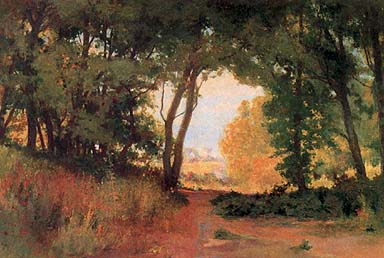
Scene in Draper, Utah (1900), past John Hafen.
In contempo years, the proficiency attained by these and later LDS artists has been increasingly recognized. A recent revival of Impressionist art and a popular exhibit at the Museum of Church History and Art have brought renewed attention and considerable appreciation for the work of these artists who harvested the light during an art mission to Paris nigh a hundred years ago.
Source: https://www.churchofjesuschrist.org/study/ensign/1988/10/harvesting-the-light-the-1890-paris-art-mission?lang=eng
0 Response to "The Paris Art Missionaries ââ“ John Hafen Lorus Pratt John Fairbanks"
Post a Comment