San Jose Catholic Church Next to Modern Art Museum
 Façade of capilla (chapel) at | |
| Location on Monterey Peninsula | |
| Location | 3080 Rio Road, Carmel-by-the-Sea, California 93923 |
|---|---|
| Coordinates | 36°32′34″N 121°55′seven″W / 36.54278°Northward 121.91861°W / 36.54278; -121.91861 Coordinates: 36°32′34″N 121°55′7″W / 36.54278°N 121.91861°W / 36.54278; -121.91861 |
| Proper noun as founded | La Misión San Carlos Borromeo del Río Carmelo [1] |
| English translation | The Mission of Saint Charles Borromeo of the Carmel River |
| Patron | Saint Charles Borromeo[2] |
| Nickname(due south) | "Male parent of the Alta California Missions" [iii] |
| Founding date | June iii, 1770[4] |
| Founding priest(s) | Male parent Presidente Junípero Serra[5] |
| Founding Order | Second[two] |
| Headquarters of the Alta California Mission Organization | 1771–1815; 1819–1824; 1827–1830 [half dozen] |
| Military machine district | Third [7] |
| Native tribe(s) Spanish name(s) | Esselen, Ohlone Costeño |
| Native identify name(south) | Ekheya [eight] |
| Baptisms | three,827[9] |
| Marriages | i,032[nine] |
| Burials | 2,837[ix] |
| Secularized | 1834[2] |
| Returned to the Church building | 1859[2] |
| Governing trunk | Roman Catholic Diocese of Monterey |
| Current use | Parish Church/Small-scale Basilica |
| U.Due south. National Register of Celebrated Places | |
| Official name: Carmel Mission | |
| Designated | Oct fifteen, 1966[x] |
| Reference no. | 66000214[10] |
| U.S. National Historic Landmark | |
| Designated | October 9, 1960[11] |
| California Historical Landmark | |
| Reference no. |
|
| Website | |
| http://carmelmission.org | |


Mission San Carlos Borromeo del Río Carmelo, or Misión de San Carlos Borromeo de Carmelo, first built in 1797, is one of the most authentically restored Roman Catholic mission churches in California. Located at the mouth of Carmel Valley, California, information technology is on the National Register of Historic Places and is a National Celebrated Landmark.
From 1797 until 1833, Carmel Mission was the headquarters of all Alta California missions. It was headed past Saint Junípero Serra from 1770 until his death in 1784. It was besides the seat of the second missions presidente, Father Fermín Francisco de Lasuén, who was in charge of completing nine more mission churches.
In 1833 the mission buildings and lands were secularized by the Mexican government. By the mid-19th century, the Carmel Mission structures had fallen into busted. The chapel was saved from total devastation when the roof was rebuilt in 1884.[13] [14] In 1886, ownership of the mission was transferred from a group of Franciscans to the Diocese of Monterey. Ever since, Carmel Mission has been a parish inside that Diocese.
Beginning in 1931, Harry Downie began restoring the mission and worked continuously on the project for the next 50 years. It is the only Spanish mission in California that has its original bell and bell tower.[15]
History [edit]

Lithograph of Carmel Mission in 1854
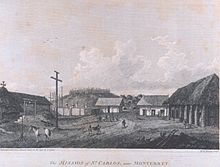
"The Mission of St. Carlos about Monterrey" in 1792, from: "A Voyage of Discovery to the North Pacific Ocean and Round the Globe" by Captain George Vancouver.

The mission in ruins, 1880.
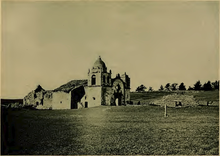
The San Carlos Mission circa 1893.
Mission Carmel (a.k.a. The Carmel Mission), was the second mission built by Franciscan missionaries in Upper California. Information technology was commencement established as Mission San Carlos Borromeo in Monterey, California near the native village of Tamo on June 3, 1770, past Begetter Junípero Serra. Information technology was named for Carlo Borromeo, Archbishop of Milan, Italy, and was the site of the first Christian confirmation in Alta California.[five]
Relocation to Carmel Valley [edit]
Pedro Fages, who served every bit military governor of Alta California from 1770 to 1774, kept his headquarters in the polity's capitol, at the Presidio of Monterey. Fages worked his men very harshly and was seen equally a tyrant. Serra intervened on behalf of Fages' soldiers, and the two men did not get along.[16] [17] Fages regarded the Spanish installations in California as military institutions showtime, and religious outposts second. The soldiers raped the Indian women and kept them as concubines.[xvi] Serra wanted to put some distance between the mission's neophytes and Fages' soldiers.
Serra found that the land near the mouth of the Carmel River (named Río del Carmelo by Vizcaíno in 1603[xviii]) was better suited for farming.[19] In May 1771, Espana'southward viceroy approved Serra'south petition to relocate the mission. The mission was established in the new location on August 1, 1771; the first mass was celebrated on August 24, and Serra officially took up residence in the newly constructed buildings on December 24.[xx]
The name of the relocated mission was extended to Mission San Carlos Borromeo del Río Carmelo. Information technology was within a brusque distance of the Rumsen Ohlone villages of Tucutnut and Achasta. The latter village may have been founded subsequently Mission San Carlos was relocated to Carmel Valley. The mission was about 10 miles (16 km) from the nearest Esselen territory, Excelen.[21] The original building in Monterey continued to operate as the Royal Presidio chapel and afterwards became the current Cathedral of San Carlos Borromeo.
Serra's headquarters [edit]
"Mission Carmel", as it came to be known, was Serra's favorite[22] and, because information technology was close to Monterey, the capital of Alta California, he chose it as his headquarters. When he died on Baronial 28, 1784, he was interred beneath the chapel floor. After Serra's death, Father Fermín Lasuén replaced the adobe structure with 1 fabricated of stone quarried from the nearby Santa Lucia Mountains.[23]
Indian baptisms [edit]
After the Carmel mission was moved to the mouth of Carmel Valley, the Franciscans began to baptize some natives.[24] By the cease of 1771, the population of the mission was 15 with an boosted 22 baptized Indians, out of a total population of northern California of sixty.[19]
Farming was non very productive and for several years the mission was dependent upon the arrival of supply ships.[xix] Historian Jame Culleton wrote in 1950, "The summer of '73 came without bringing the supply ship. Neither Carmel nor Monterey was anything like self-supporting."[19]
To improve baptismal rates, they sought to convert key members of the Esselen and Rumsen tribes, including chiefs. On May 9, 1775, Junípero Serra baptized what appears to be the first Esselen, Pach-hepas, the forty-year-quondam primary of the Excelen. He was most death and was baptized in his home village at Xasáuan,[25] about 10 leagues (most 26 miles (42 km)) southeast of the mission, in an area now named Cachagua, a close approximation of the Esselen proper noun.[21]
Forced labor [edit]
The Esselen and Ohlone Indians who lived near the mission were baptized then forcibly relocated and conscripted as forced laborers. Over the years about 900 Esselen were baptized and brought to the three missions at Carmel Valley, Soledad, and San Antonio that surrounding their native land.[25] There was all-encompassing "comingling of the Costanoan with peoples of different linguistic and cultural background during the mission period."[24] The neophytes were taught to be farmers, shepherds, cowboys, blacksmiths, carpenters, bricklayers, piece of furniture makers, tanners, weavers and candle makers. Disease, starvation, overwork, and torture decimated these tribes.[26] [27] : 114 The number of natives who died at the missions were high. Deaths exceeded births and the population at Mission San Carlos peaked in 1795,[25] when the population reached a total reported variously equally either 876 or 927, but by 1823 the total had dwindled to 381.[28] [26]
Crops and livestock [edit]
In the beginning, the mission relied on bear meat from Mission San Antonio de Padua and supplies brought by ship from Mission San Diego de Alcalá.[19] In 1779, 4 years after the first Esselen baptism, the Native Americans at Carmel Mission harvested 1,660 bushels of wheat, 700 bushels of barley, 165 bushels of beans, and 85 bushels of maize. Four years after, the native laborers produced plenty crops to support 700 people. The mission had more than 500 cattle and sheep.[26]
Carmel mission connected to grow during well-nigh of the 18th century. By 1800, agriculture production at Carmel Mission was about its summit. The Mission reported to Mexico that information technology had 2,180 horses and cattle, and 4,160 smaller livestock, including sheep. The total grain harvested was about iii,700 bushels per year with a high of 7,400 in 1797.[26] In December 1832, the mission reported to Mexico that it had 2,100 cattle, iii,300 sheep, 410 horses, and 8 mules.[29]
Secularized and abandoned [edit]
The Mexican government was concerned that the missions remained loyal to the Catholic Church in Spain. Only viii months later on, in August 1833, the government secularized all of the missions and their valuable lands. The authorities stipulated that half the mission lands should be awarded to the native people, but this purpose was never accomplished. Most mission property was bought by authorities officials or their wealthy friends.[26] The priests could not maintain the missions without the Indians' forced labor and the mission and lands were soon abandoned. The Indians were forced from the mission by the new landowners. Some attempted to return to their native ways, and others constitute work as ranch hands or servants on farms and ranches.[23]
By 1850, the mission was nearly a ruin. The stone chapel building was deteriorating while about of the adobe buildings were eroding abroad. The roof complanate in 1852.[29]
Restoration [edit]

Interior view of the façade of the capilla (chapel) in 1880 prior to restoration.
When Mexico ceded California to the United States post-obit the Mexican–American War, the 1848 Treaty of Guadalupe Hidalgo provided that the land grants would be honored, but required that the owners provide legal proof of their title. As required by the Country Act of 1851, Archbishop Joseph Sadoc Alemany filed a claim on Feb 19, 1853, on behalf of the Roman Cosmic Church. He sought return of all former mission lands in the Country. The state agreed to return the original mission buildings, cemeteries, and gardens to the church.[thirty] : 31–32
When the Roman Catholic Church gained full control of the buildings on October 19, 1859, the mission was in ruins.[23] In 1884 Father Angel Casanova was able to gather plenty individual funds to replace the roof on the chapel sufficient to preserve information technology until the 1930s. In 1931 Monsignor Philip Scher hired master cabinet maker Henry John ("Harry") Downie who had an excellent reputation for restoring Spanish antiques. Scher initially asked Downie to restore some statues at the Carmel Mission simply his job quickly expanded and he was put in charge of restoring the entire mission.[31] [29] Two years later on, the church building transferred the mission from the Franciscans to the local diocese and it became a regular parish church. Downie lived nearby in Carmel and worked virtually daily for nearly fifty years to restore the mission, ancillary buildings, walls, and grounds. He painstakingly researched the church'due south architecture and site, oft relying on original Castilian sources, and gathered genuine artifacts from across California.[23]
He starting time restored the padres' quarters, then the roof of the chapel in 1936, and over the adjacent 5 years the interior of the basilica.[23] [32] In 1941, he oversaw restoration of the old soldiers' quarters on the east side of the quadrangle. In 1943 he began restoration of a building that had been on the southward side of the quadrangle, although nothing was left but the eroded adobe foundation and a few ruined walls. The edifice was originally a segregated, locked dormitory for girls called the monjero (nunnery). They were separated from their families at age 8. The boys and unmarried men likewise had their own dormitory, though it was less confining.[33] : 117–119
The building was reconstructed and made into classrooms for Junipero Serra Simple School. In 1946, the ruin on the east side of the quadrangle that had been the original padre'southward kitchen and a blacksmith shop was rebuilt. Information technology is used today as a chapel. Downie also consulted on the restoration of the missions that are considered the virtually accurate, including San Luis Obispo, San Juan Bautista, and San Buenaventura. He also helped the Native Daughters of the Gilt West to reconstruct Mission Soledad.[31] He was knighted by Pope Pius and by King Juan Carlos of Kingdom of spain.[34] [23]
In 1960, the mission was designated as a pocket-size basilica past Pope John XXIII. In 1987, Pope John Paul 2 visited the mission every bit role of his U.South. bout.[35] [36]
The original bong nicknamed Ave Maria was made in Mexico Metropolis in 1807. Information technology was placed at the Mission in 1820. When the mission was secularized in 1834, the bong was removed and held onto by local Native Americans for safekeeping. It was finally lost, but relocated once again, during restoration. Information technology was re-installed in the mission bell tower in 1925.[xv] [37]
Modern use [edit]

Present-day retablo inside basilica.
Equally a result of Downie's dedicated efforts to restore the buildings, the Carmel mission church building is i of the most authentically restored of all the mission churches in California. Mission Carmel has been designated a National Historic Landmark by the National Park Service. Information technology is an agile parish church of the Roman Catholic Diocese of Monterey.[38] [39]
In addition to its activity as a place of worship, Mission Carmel as well hosts concerts, art exhibits, lectures, and numerous other community events. In 1986, so-pastor Monsignor Eamon MacMahon acquired a Casavant Frères organ with horizontal trumpets. Its hand-painted casework is decorated with elaborate carvings and statuary reflecting the Spanish decorative style seen on the primary chantry.[ citation needed ]
The mission as well serves as a museum, preserving its own history and the history of the surface area. At that place are 4 specific museum galleries: the Harry Downie Museum, describing restoration efforts; the Munras Family Heritage Museum, describing the history of one of the most important area families; the Jo Mora Chapel Gallery, hosting rotating art exhibits likewise as the awe-inspiring bronze and travertine cenotaph (1924) sculpted by Jo Mora;[40] and the Convento Museum, which holds the cell Serra lived and died in, also equally interpretive exhibits. At ane stop of the museum is a special chapel room containing some of the vestments used by Serra.[41] [28] [42]
The mission grounds are also the location of the Junípero Serra School, a private Cosmic school for kindergarteners through eighth grade.[43] At the end of the 2019–2020 academic yr, it was appear that the school is closed.[44]
Modernistic restoration [edit]
Between 2000 - 2007 private funding paid for the painting conservation of the major original Spanish Colonial oil paintings in the nave past Fine Art Conservation Laboratories, a professional person art conservation facility extensively experienced in the preservation and restoration of Spanish Colonial Art from the Mission Inn, Riverside, CA, the Santa Barbara Mission, The Establish of Iberian Art in Santa Atomic number 26, NM and from the Permanent Art Collection of Brigham Immature University. The most important artwork conserved at this time was the "Deposition," a painting commissioned by Father Serra prior to his death which at present hangs in the vicinity of his tomb in the apse of the Carmel Mission.[45]
In 2008, a public clemency was formed, independent of the Diocese of Monterey, named the Friends of Historic Carmel Mission, to aid the Parish and Diocese in restoring and preserving this national and state historic landmark for hereafter generations. Afterwards restoring 9 mission bells, and many artifacts, the Foundation became the sole funder for these restorations and changed their proper noun to the Carmel Mission Foundation to continue the monumental work of restoring this historic property. In 2012, the Foundation began their first major capital restoration of the renowned Basilica, which had not been touched since 1937 and was deemed unsafe by the California State Unreinforced Masonry Act. The project was the third major reconstruction of the Basilica since it was built in 1797. The contractors installed additional woods and steel beams to reinforce and necktie the roof structure together. To strengthen the walls, they drilled over 300 center-cored vertical and horizontal holes in the 5 feet (1.5 yard) thick walls, into which they inserted steel rods that were grouted in place. The bell tower dome was reinforced, cleaned and resurfaced. The project too updated the electrical system and added a fire suppression system. The interior lighting was replaced, and custom-made chandeliers were added. Foundational problems were remedied and all tile was matched and restored to make sure it looked as it always has. The project upgraded the radiant heating system and included construction of an Americans with Disabilities Human activity-compliant restroom. The $vi.2 million[39] project was 100% funded by the Carmel Mission Foundation and the Basilica restoration was completed in 2013.
Over the next few years, The Foundation continued working with the Mission administration to restore many artifacts throughout the museum and preserved historic structures from further disuse, such every bit the Muchado House built in 1883, until the necessary funds to restore these structures were raised. In 2016, the Foundation designed and funded the restoration of the Central Courtyard at a price of $2.2 million. The chancy uneven, cracked concrete surface was removed and new h2o and burn lines, drains, sewer, electrical, and communications lines were installed earlier a more than durable physical surface was poured to match that of the original aggregate poured in the belatedly 1960's .[39] The iconic fountain was restored fixing all plumbing issues. The large Santa Maria fashion BBQ pits were reinforced and upgraded to proceed the heritage of the large community BBQs at Carmel Mission since 1913. The gardens were revived with native plants and outdoor lighting and electrical was installed for outdoor community events. The Foundation also created the Serra Memorial Circle in the Courtyard, to honor those in perpetuity who have contribute to the restoration of this incredible landmark. Surrounding the retired Ave Maria Bell from 1807 that in one case hung from the bell tower, plaques and stones have been engraved for those who have contributed to this restoration work.[46]
The Foundation continues ongoing artifact restoration through the Mission Museum. Together with the Mission Docent Association they were able to conserve the Our Lady of Bethlehem statue, considered one of the oldest statues in California, dating back to the 16th century, which is now on display in the Carmel Mission Basilica. In 2020 the forepart Perimeter wall deteriorated and the foundation, along with their donors, was able to fully fund the emergency removal of 30ft perimeter wall and the construction of a temporary wall until a permanent one could be designed and built.[47]
In fall of 2020 The Camel Mission Foundation began their third major capital restoration to restore the century erstwhile Downie Museum and the Basilica front courtyard. Throughout the heart of a global pandemic the Foundation was able to blueprint and fund this $iv million project in fourth dimension to commemorate the 250th anniversary of the founding of Carmel Mission. This project seismically strengthened the 100-year-erstwhile Downie Museum adobe, which was the first structure built from ruins equally a visiting priest quarters in order to open the Mission regularly in 1921. This building was dedicated a museum in 1980 to honor the mission's great restorer, Sir Harry Downie, adding images of Harry Downie'due south restoration years and artifacts unearthed during excavations to one side of the building. The other side of the building was turned into restrooms which were only marginally operation in 2020. This restoration removed these restrooms doubling the museums interior infinite for future exhibits. The historic fireplace was restored removing years of overlay painting showcasing the original rock installed in 1920. The Basilica Courtyard, which had settled overtime was resurfaced. New drainage systems was added to eliminate the h2o pooling at the Basilica Bong tower and surrounding adobe buildings. The fountain was restored and leveled to piece of work correctly and the garden beds were revived. All walkways were widened and made step gratis offering ADA accessibility throughout the garden and into the Downie Museum.[48]
With the Mission'southward master museums and the historic orchard house belongings forth with countless artifacts, still in need of restoration and masonry reinforcement, the foundation has much more than to do. Together with their donors and the parish they are currently raising funds to appraise the remaining structures restoration needs. This includes seismic retrofits, infrastructure improvements, and restoration of the several historic structures, including the Mora Museum, Convento Museum (including the museum shop), Blessed Sacrament Chapel, and the historic Orchard Firm Belongings.[39]
Vandalism [edit]
On September 27, 2015, in response to Serra'due south canonization, the San Carlos Borromeo de Carmelo Mission was vandalized. The statue of Serra was toppled and splattered with paint, and the cemetery, the mission doors, a fountain, and a crucifix were every bit well. The message "Saint of Genocide" was painted on the ground, and similar messages were painted elsewhere in the mission courtyard.[49] [l]
Notable interments [edit]

St. Junípero Serra'due south grave within the church
Several notable people are buried in the church and churchyard.[51]
- Juan Crespí (1721–1782), Spanish missionary and explorer
- Fermín Lasuén (1736–1803), Spanish missionary and explorer
- José Antonio Roméu, (1742? – 1792) Spanish governor of California
- Junípero Serra (1713–1784), founder of the Spanish missions in California and Saint
See also [edit]
- Castilian missions in California
- List of Spanish missions in California
- Cathedral of San Carlos Borroméo (aka Royal Presidio Chapel), Monterey, California
- USNS Mission Carmel (AO-113), a Buenaventura Class fleet oiler built during Earth War 2.
- USNS Mission San Carlos (AO-120), a Buenaventura Class fleet oiler built during World War 2.
References [edit]
- ^ Leffingwell, p. 113
- ^ a b c d Krell, p. 83
- ^ Ruscin, p. 25
- ^ Yenne, p. 33
- ^ a b Ruscin, p. 196
- ^ Yenne, p. 186
- ^ Forbes, p. 202
- ^ Ruscin, p. 195
- ^ a b c Krell, p. 315: as of December 31, 1832; information adapted from Engelhardt's Missions and Missionaries of California.
- ^ a b "National Register Data System". National Register of Celebrated Places. National Park Service. July 9, 2010.
- ^ NHL Summary Archived 2008-06-21 at the Wayback Automobile
- ^ "Mission San Carlos Borromeo de Carmelo". Office of Historic Preservation, California Country Parks. Retrieved 2012-11-23 .
- ^ Dillon, James (September 4, 1976). "Mission San Carlos De Borromeo Del Rio Carmelo" (pdf). National Register of Historic Places – Inventory Nomination Class. National Park Service. Retrieved 22 May 2012.
- ^ "Mission San Carlos De Borromeo Del Rio Carmelo" (pdf). Photographs. National Park Service. Retrieved 22 May 2012.
- ^ a b "News from California Missions Foundation". archive.constantcontact.com . Retrieved 15 May 2018.
- ^ a b Walton, John (2003). Storied Land: Community and Retention in Monterey. Berkeley, Calif.: University of California Press. p. 15ff. ISBN978-0-520-93567-9 . Retrieved 5 September 2016.
- ^ Paddison, p. 23
- ^ Clark, Donald Thomas. 1991. Monterey County Place Names: a Geographical Dictionary. Carmel Valley, Calif: Kestrel Printing.
- ^ a b c d eastward Breschini, Ph.D., Gary South. (2000). "Mission San Carlos Borromeo (Carmel)". Monterey Canton Historical Museum. Archived from the original on 2 November 2013. Retrieved 22 June 2013.
- ^ Smith, p. 18
- ^ a b Breschini, Gary South.; Trudy Haversat. "A Brief Overview of the Esselen Indians of Monterey Canton". Monterey Canton Historical Society. Retrieved November iii, 2011.
- ^ Gondosch, Linda. "Carmel Mission in California". American History Tales (blog). Wordpress. Retrieved 3 April 2017.
- ^ a b c d east f "Mission History – Carmel Mission". carmelmission.org . Retrieved 15 May 2018.
- ^ a b "Native Americans of San Carlos Borromeo de Carmelo". California Missions Resource Center . Retrieved xxx October 2015.
- ^ a b c Breschini, Gary S.; Haversat, Trudy. "A Cursory Overview of the Esselen Indians of Monterey County". www.esselen.com. Archived from the original on 27 July 2011. Retrieved 21 Jan 2019.
- ^ a b c d e "How it all Started". Carmel Mission . Retrieved xvi May 2018.
- ^ Pritzker, Barry M. (2000). Encyclopedia: History, Culture, and Peoples . Oxford [u.a.]: Oxford Univ. Press. ISBN978-0-19-513877-1.
- ^ a b "Mission San Carlos de Borromeo de Carmelo". athanasius.com.
- ^ a b c "Carmel Mission Foundation". world wide web.carmelmissionfoundation.org . Retrieved 15 May 2018.
- ^ Robinson, William Wilcox (Jan 10, 2012). Land in California, the Story of Mission Land, Ranches, Squatters, Mining Claims, Railroad Grants, Land Scrip, Homesteads. HardPress Publishing. p. 322. ISBN978-i-4076-9580-8.
- ^ a b "Harry Downie Scrapbook". www.oac.cdlib.org . Retrieved 16 May 2018.
- ^ "Mission Today". Carmel Mission . Retrieved 16 May 2018.
- ^ Fogel, Daniel (1988). Junípero Serra, the Vatican and Enslavement Theology. San Francisco: Ism Printing. ISBN978-0-910383-25-7.
- ^ "Carmel Projects". www.studiob6.com . Retrieved xv May 2018.
- ^ "San Carlos Borroméo de Carmelo Mission: Mission History". 31 January 2009. Archived from the original on 2009-01-31.
- ^ "Carmel Mission, Junipero Serra'south favorite identify". See California. See California. Retrieved 3 April 2017.
- ^ "Carmel Mission – A Peek into California's Past | Uncharted101.com". www.uncharted101.com . Retrieved 16 May 2018.
- ^ "San Carlos Borromeo de Carmelo". missionscalifornia.com.
- ^ a b c d "Restoration". Carmel Mission Foundation. Retrieved 15 May 2018.
- ^ Edwards, Robert W. (2012). Jennie 5. Cannon: The Untold History of the Carmel and Berkeley Art Colonies, Vol. ane. Oakland, Calif.: Due east Bay Heritage Projection. pp. 523–525, 690. ISBN978-1-4675-4567-nine. An online facsimile of the entire text of Vol. ane is posted on the Traditional Fine Arts Organization website ("Archived copy". Archived from the original on 2016-04-29. Retrieved 2016-06-07 .
{{cite web}}: CS1 maint: archived re-create as championship (link)). - ^ "Museum – Carmelmission". www.carmelmission.org.
- ^ "Californias-Missions.org: Mission San Carlos". californias-missions.org.
- ^ "Junipero Serra School". juniperoserra.org.
- ^ Copitch, Josh (2020-05-09). "Junípero Serra School to close, citing COVID-xix pandemic equally last straw". KSBW . Retrieved 2020-06-fifteen .
- ^ Entered by Scott K. Haskins, Fine art Conservator
- ^ https://www.carmelmissionfoundation.org/get-involved/serra-tiles-2/
- ^ https://www.carmelmissionfoundation.org/wp-content/uploads/2021/05/CMF_news_Spring2021.pdf
- ^ https://www.carmelmissionfoundation.org/restoration/downie-museum-basilica-forecourt-restoration/
- ^ Liam Stack, "Vandals Desecrate Carmel Mission Where Junípero Serra Is Buried", New York Times, September 28, 2015, http://mobile.nytimes.com/2015/09/29/u.s./carmel-california-junipero-serra-pope-francis-vandalism.html.
- ^ "statue of st junipero serra defaced at californias carmel mission".
- ^ "Carmel Mission Cemetery in Carmel-past-the-Body of water, California - Observe A Grave Cemetery". world wide web.findagrave.com . Retrieved 2020-06-fifteen .
Bibliography [edit]
- Forbes, Alexander (1839). California: A History of Upper and Lower California. Smith, Elder and Co., Cornhill, London.
- Jones, Terry L. and Kathryn A. Klar (eds.) (2007). California Prehistory: Colonization, Civilization, and Complexity. AltaMira Press, Landham, MD. ISBN978-0-7591-0872-1.
- Krell, Dorothy, ed. (1979). The California Missions: A Pictorial History. Sunset Publishing Corporation, Menlo Park, CA. ISBN0-376-05172-eight.
- Leffingwell, Randy (2005). California Missions and Presidios: The History & Beauty of the Castilian Missions. Voyageur Printing, Stillwater, MN. ISBN0-89658-492-five.
- Paddison, Joshua, ed. (1999). A Earth Transformed: Firsthand Accounts of California Before the Golden Rush . Heyday Books, Berkeley, CA. ISBN1-890771-13-9.
- Ruscin, Terry (1999). Mission Memoirs. Sunbelt Publications, San Diego, CA. ISBN0-932653-30-viii.
- Smith, Frances Rand (1921). The Architectural History of Mission San Carlos Borromeo, California. California Historical Survey Commission, Berkeley, CA.
- Vancouver, George (1801). A Voyage of Discovery to the N Pacific Ocean and Round the Globe, Volume Three. Printed for John Stockdale, Piccadilly, London.
- Yenne, Nib (2004). The Missions of California. Advantage Publishers Group, San Diego, CA. ISBN978-0-8118-3694-four.
External links [edit]
- Official Mission San Carlos Borromeo de Carmelo website
- Native American life at Mission San Carlos Borromeo
- Elevation & Site Layout sketches of the Mission proper
- Early photographs, sketches, country surveys of Carmel Mission, via Calisphere, California Digital Library
- List and photographs at the Celebrated American Buildings Survey
- Howser, Huell (December viii, 2000). "California Missions (105)". California Missions. Chapman Academy Huell Howser Archive.
- Photographs of the mission and courtyard
- Carmel Mission Cemetery at Observe a Grave
- U.South. Geological Survey Geographic Names Information System: Mission San Carlos Borromeo de Carmelo
Source: https://en.wikipedia.org/wiki/Mission_San_Carlos_Borromeo_de_Carmelo
0 Response to "San Jose Catholic Church Next to Modern Art Museum"
Post a Comment