Tales of Destiny 2 How Do You Know a Recipe Is Mastered
| Tales of Destiny | |
|---|---|
 | |
| Information | |
| Game Systems | PlayStation 2 |
| Developers | Namco Tales Studio |
| Publishers | Bandai Namco Games |
| Character Designers | Mutsumi Inomata |
| Composers | Motoi Sakuraba Shinji Tamura |
| Animators | Production I.Thou |
| Japanese Releases | PS2 November thirty, 2006 PS2 DC January 31, 2008 |
| Opening Theme | "Yume de Aru You ni" by Deen |
| Ratings | PS2 CERO: A (all ages) PS2 DC CERO: A (all ages) |
The PlayStation 2 release of Tales of Destiny (テイルズ オブ デスティニー , Teiruzu obu Desutinii ? ) is a full remake of the original PlayStation release of Tales of Destiny. This remade version of the game was released on November 30, 2006, followed past an boosted Director's Cut version, which was released on Jan 31, 2008, also on the PlayStation 2. Neither version of this remake has been localized.
Identical to its original release, this remake features an introductory video created past the renowned animation studio Production I.G, accompanied with the song "Yume de Aru Yous ni", performed by the J-pop band Deen. Mutsumi Inomata returns as a graphic symbol designer, creating several newly-revised designs and artwork for each graphic symbol. Motoi Sakuraba and Shinji Tamura also render as the composers for this game, fully remixing all of the music from the original game while providing some new original compositions for various added events.
This remake of Tales of Destiny features a new characteristic genre, translated to "RPG Known every bit Fate" (運命という名のRPG , Unmei to Iu na no RPG ? ). This change represents the alterations that accept been fabricated in all aspects of the game while preserving the basics that defined the original game.
Contents
- one Characters
- i.i Protagonists
- 1.2 Antagonists
- 2 Gameplay
- 2.1 Standard Gameplay
- 2.2 Emotional Card Chat
- 2.3 Battle Gameplay
- ii.4 Other Additions
- 3 Tales of Destiny: Director's Cut
- three.ane Major Changes
- 4 Trivia
- 5 External Links
Characters
Protagonists
- Stahn Aileron (スタン・エルロン , Sutan Eruron ? , "Stan Aileron") - A young nineteen-year-old adventurer who grows into a powerful sword-based physical fighter, Stahn is the protagonist of the game. Not known for his intelligence or his cultured groundwork, his Fire-elemental Swordian is Dymlos.
- Rutee Katrea (ルーティ・カトレット , Ruuti Katoretto ? , "Rutee Kartret") - Armed with Atwight, the Swordian of Water, eighteen-year-old Rutee is a headstrong Lens-hunter who travels the earth looking to make a profit with her partner, Mary Argent. She has a bad reputation in the Kingdom of Seinegald because of her money-hungry means, simply she does non let it bother her.
- Leon Magnus (リオン・マグナス , Rion Magunasu ? , "Lion Magnus") - Leon is a master swordsman of Seinegald. At age 16, he is the youngest in history to serve the kingdom, and a close associate of Hugo Gilchrist, his begetter and the president of the powerful Oberon Corporation. A complex and slightly heart-searching grapheme, Leon's active Swordian is Chaltier.
- Philia Felice (フィリア・フィリス , Firia Firisu ? , "Philia Philis") - A 19-year-quondam priestess at Straylize Temple studying the Aeth'er Wars era, Philia is isolated from the outside world until the events of the game. She has a sweet, charming personality and is very dependable, simply she can besides exist overly fastidious. Her powerful spellcasting ability is augmented by her Swordian, Clemente, but her physical attacks are weak.
- Garr Kelvin (ウッドロウ・ケルヴィン , Uddoroo Keruvin ? , "Woodrow Kelvin") - The 23-yr-one-time Prince of Phandaria, Garr is a skilled archer and swordsman. Igtenos is his Air current-elemental Swordian.
- Mary Silver (マリー・エージェント , Marii Eejento ? , "Mary Agent") - Suffering from amnesia, 24-year-old Mary is non enlightened of her last name due to an unknown event in her past. Mary has no Swordian but can utilise axes as a stiff concrete assailant. Rutee uses Mary for her own financial gain.
- Chelsea Torn (チェルシー・トーン , Cherushii Toon ? , "Chelsea Tone") - The fourteen-year-onetime granddaughter of Garr'due south archery master, Alba Torn. Although she appears beautiful and innocent, Chelsea is an archer skilled beyond her mere 14 years of age. She is a skillful long-ranged attacker with her bow, but not a Swordian user.
- Karyl Sheeden (ジョニー・シデン , Jonii Shiden ? , "Johnny Shiden") - An estranged 26-year-old son of an aristocratic family unit, Karyl is a bard past merchandise. He may seem fragile from outward appearances, merely he tin can provide useful support in the party through songs played on his lute.
- Bruiser Khang (マイティ・コングマン , Maiti Konguman ? , "Mighty Kongman") - A 39-year-old powerful fighter from the battle arena, Bruiser is an optional grapheme in the original game. Nonetheless, he forcibly joins Stahn's group in the remake. Using his fists as a weapon, he is the undefeated champion of the world when it comes to battling in the arena.
- Lilith Aileron (リリス・エルロン , Ririsu Eruron ? ) - Stahn'southward 17-year-old sister, who is very concerned about him and wishes he would not continue such dangerous adventures, Lilith was a dummied graphic symbol available but through use of a Game Shark or similar device in the original version of the game. In the remakes, however, she becomes an optional playable grapheme.
Antagonists
- Batista Diego (バティスタ・ディエゴ , Batisuta Diego ? ) - A minor antagonist who, prior to the events of the story, was Philia's colleague, living and working with her at the Straylize Temple of the Seinegald region.
- Tiberius Terazzi (ティベリウス・トウケイ , Tiberiusu Toukei ? ) - The King of Aquaveil who lives in the capital kingdom of Terazzi, subsequently which he is named.
- Dalis Vincent (ダリス・ヴィンセント , Darisu Vuinsento ? ) - A minor adversary and after a supporting graphic symbol, Dalis is revealed to exist Mary's hubby, playing a vital role in her backstory of recovering her memories.
- Lydon Bernhardt (グレバム・バーンハルト , Gurebamu Baanharuto ? , "Greybum Bernhardt") - The primary protagonist during the initial half of the game's story, Lydon is a High Priest of the Straylize Temple who steals the Eye of Atamoni, leading the protagonists on a worldwide hunt for him.
- Baruk Songram (バルック・ソングラム , Barukku Songuramu ? ) - A supporting graphic symbol and later a modest antagonist, Baruk serves as the Oberon branch director of the Calvalese region, with headquarters stationed in the desert port town of Cherik.
- Ilene Rembrandt (イレーヌ・レンブラント , Ireenu Renburanto ? , "Irene Rembrandt") - A supporting character and later a minor antagonist, Ilene is a high-ranking executive member of the Oberon Corporation, serving every bit its branch managing director inside the Fitzgald region.
- Shane Rembrandt (シャイン・レンブラント , Shain Renburanto ? , "Polish Rembrandt") - A supporting character and later on a minor antagonist, Rembrandt is a scientist and Oberon Corporation executive who lives in the Seinegaldian capital of Darilsheid.
- Hugo Gilchrist (ヒューゴ・ジルクリスト , Hyuugo Jirukurisuto ? ) - The primary antagonist during the 2nd part of the game's story, Hugo is the President of the Oberon Corporation and serves as one of the closest advisers to the Male monarch of Seinegald.
- Kronos (ミクトラン , Mikutoran ? , "Miktran") - The terminal antagonist of the game, Kronos is the leader of an aboriginal people known as the Aetherians, people who lived in the sky and ruled over the Er'thers, the people on the ground.
Gameplay
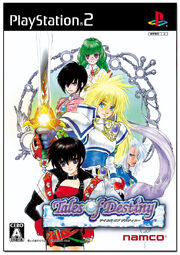
Comprehend for the original edition of the game.
Standard Gameplay
Unlike the original game, it is now possible to ready a different character in the first actor's position, allowing the chief role player to command any graphic symbol in the party during battle. It is likewise possible to select a different character to represent the political party outside of battle, regardless of his or her position within the party roster, though this option is purely artful with no changes to gameplay. Eight of the ten playable characters join the party as part of the story by the stop of the game, providing access to all of the non-Swordian Master characters from the original game inside the political party. The original game allowed merely up to 2 of these characters to participate within the party throughout the final areas. An additional cloak-and-dagger character, Lilith, was added to this game as a optional 9th member of the party, as an homage to her unfinished and dummied status within the original game, as well as her appearances equally a cameo exhibition battle in other games.
Every character has a unique support talent that is activated under diverse conditions while the character is added to a special "support" position within the political party roster. This grapheme slot becomes bachelor afterwards the political party expands to five characters. These functions can exist used to reduce enemy run into rates or acquire various items such as herbs or fruits. All towns and dungeons are represented past isometric three-dimensional maps viewed through dynamic photographic camera motion while the character moves through the expanse, providing a more three-dimensional experience. Different the original game, most indoor locations no longer characteristic bath fixtures.
The World Map is fully rendered in 3-dimensional polygon graphics, including a simplified 3D model of the character avatar that represents the party. Camera view can be rotated freely to both sides, and the camera zooms in or out automatically to prevent terrain from obstructing the player's view of the character. Zoom functions cannot be controlled direct by the player. This method of world map display originated with Tales of Destiny 2, and the graphics style was taken directly from that game as an homage to the relationship between the stories of the ii games. Transportation on the globe map includes standard motion on the ground, ocean travel within a Sea Dragon vessel, and flying within the Draconis and the upgraded Lumina Draconis airships. Boxing encounters in dungeons and on the earth map are random based a Lens judge at the top-left corner of the screen. As the character walks in enemy-infested areas, the purple color of the lens gets progressively darker while a glyph within the lens becomes more prominent. When the color of the lens becomes brilliant purple, a battle run across is initiated. Subsequently the end of that boxing, the gauge is reduced past a random amount, generally resulting in a paler shade of blue until the gauge is built upwardly again.
All music within the game has been remixed, and several new songs accept been added to the soundtrack. One significant modify involves the standard battle themes within the game. The original game's two chief boxing themes, "Blank Its Fangs" and "Surprise Attack!", have been reworked into the remake equally the main battle themes for the first and 2nd phases of the game, respectively. They are joined past a new 3rd master boxing theme during the third phase of the game, chosen "Progress toward the End", which is in itself another remix of "Bare Its Fangs". Some other change involves the use of the theme "Bluish Dragon" as the battle theme for Tiberius Terazzi due to the removal of the "Gourmet" sidequest that existed in the original game.
Emotional Carte du jour Chat
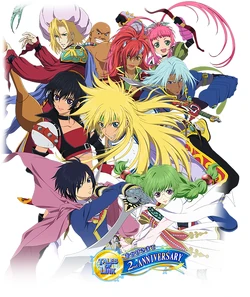
Artwork of the game'southward cast for Tales of Link.
This game introduces the Emotional Card Chat (エモーショナルカアド・チャット 「以下チャット」 , Ika Chat ? ) system, an evolution of the skit systems of previous games in the series. Like skits, these conversation events can be activated at whatever time when the characters are non involved in a battle or result scene by pressing the "Select" button ( ). All bachelor chat event titles are displayed at the bottom-left corner of the screen, and the actor can coil through each of them by pressing the "Left-Trigger" button (
 ). Recently viewed chats remain on this list until new chats are available, assuasive the role player to view the chats at any time until they are pushed off the listing.
When a conversation is activated, each character appears inside his or her own card-shaped box, showing fully animated portrait views of that character'southward face and trunk. Every bit the characters speak, they movement within these portraits to emphasize their emotions, with the background of each bill of fare irresolute to match each character'southward mood.
There are three different types of chat within this game: "navigational chat" (ナビチャット , navi chat ? ), "gratuitous chat" (フリーチャット ? ), and "rare conversation" (レアチャット ? ). Each type of chat is indicated with an icon of dissimilar colors and a letter of the alphabet that corresponds with the conversation type's name: navigational chats are shown as yellow icons with the alphabetic character "N", free chats are blue icons with the letter "F", and rare chats are red icons with the letter "R". Navigational chats tell players information that they might need to move on, often repeating things that have been said in previous event scenes. Free chats are the natural interactions between each of the characters, rarely having anything to do with the current story situation. Rare chats are available only afterwards the game has been cleared at least once, adding dialogue that further enhances the personalities of the characters.
Battle Gameplay
| Battle Icons | ||||||||||
 |  |  |  |  |  |  |  |  |  |  |
|---|---|---|---|---|---|---|---|---|---|---|
| Slash | Blunt | Pierce | Sonic | Aerial | Fire | Water | Earth | Lite | Current of air | Dark |
The original battle system of Tales of Destiny, the "Enhanced Linear Motion Battle Organisation" (East-LMBS) has been replaced by the new "Aerial Linear Movement Battle Organisation" (AR-LMBS), a battle system that was designed for aerial comboing. The AR-LMBS replaces the familiar TP organization of most previous games with the new Chain Capacity system for arte usage. This game as well introduces a new organization of comboing, in which all artes tin can be used freely in whatsoever order regardless of their rank or blazon, as long as the grapheme has enough CC to execute the arte.
Each character has a minimum and maximum CC level, which tin can be increased by equipping better weapons or Swordian Device passives. At the first of a boxing, the character has his or her CC approximate filled to its minimum level. When an assault, arte, or special action such equally "Accuse" or "Backstep" is used, the gauge depletes by a specific corporeality that the activity requires. If the character does not have enough CC bachelor, the action will not be performed. After performing any action, the character can proceed to chain more than actions until CC has been depleted.
CC recovers automatically after a short fourth dimension whenever the character does non perform whatever action that would otherwise drain CC. Bones actions such as guarding, running, and standing however do non affect the CC gauge, allowing it to recover every bit needed while providing options for defensive or evasive motility. When CC is recovered, the current CC level is increased by one point in a higher place the previous level until it hits its maximum limit. If CC is consumed while the approximate is at its maximum level, its level will return to ane point higher up the amount of CC remaining at the cease of the chain when CC is recovered, defaulting to the graphic symbol's minimum CC level if the current level is smaller than that corporeality.
Other Additions
New scenes accept been added, while some scenes from the original, such equally the appointment with Ilene Rembrandt, were removed. The remake as well includes a new battle between Stahn and Dymlos in an endeavour to regain the full strength of the Swordians. 1 of the most notorious new features is the cameo advent of one of the primary antagonists of Tales of Destiny ii, Barbatos Goetia. Barbatos appears every bit a secret random encounter if the thespian attempts to auto-level, achieved by running around in circles in the world map while setting all characters' controls to "auto". If he is encountered in this way, he cannot exist defeated, resulting in an inevitable game over and reset to the player's previous save. Barbatos also appears as the last boss in the final level of the Arcana Ruins, the surreptitious dungeon that is unlocked after clearing the game.
Another feature present in this remake is the Narikiri dolls, a reference to the costume-changing abilities of the main characters in Tales of Phantasia: Narikiri Dungeon. When the player clears the game, he or she gains access to the Arcana Ruins, a 10-floor bonus dungeon. Cyglorg, the clown who lets the player into that dungeon, allows the actor to substitution EX Points, which are earned from battles and certain treasure chests within the dungeon, for unique items such as the Narikiri dolls. These items permit the actor to completely transform a character into some other one from the party, changing the original character's battle appearance, voice, and movelist to fit the role of the new character.
All purchased Narikiri dolls are carried into each new playthrough automatically, enabling the player to use characters who might not unremarkably be available at the time due to story reasons. It is also possible to equip all four boxing party members with the same blazon of Narikiri doll, allowing the player to accept four of the aforementioned character during battle. This role can be used in conjunction with the "Single Play" and "Selector Fashion" options for a new playthrough to provide a unmarried character with a total of 24 arte shortcuts.
Tales of Destiny: Manager'due south Cut

Cover for the Director's Cut version of the game.
A Managing director'south Cut version of Tales of Destiny was appear on July twenty, 2007, and it was released on Jan 31, 2008 in Nihon for the PlayStation two. Its characteristic genre name is "One More than RPG Known equally Fate" (もうひとつの運命という名のRPG , Mou Hitotsu no Unmei to Iu na no RPG ? ), edifice on the starting time PlayStation 2 remake with additional features. This version of the game includes a new game manner called "Leon's Side". This new story mode makes Leon the main character of the game instead of the normal master character, Stahn. The original story way is still available to play, nether the new name "Stahn's Side". There is also a modest sidequest inside "Stahn'due south Side", known as "Lilith'southward Side", where Stahn's sister Lilith goes into the Tilso Forest to become herbs equally a nowadays for Stahn. "Lilith's Side" can be started past sleeping in the Frostheim inn at the end of a "Stahn's Side" playthrough. In addition to "Lilith's Side", several other sidequests have been added.
Relieve files from the first PlayStation 2 remake are withal loadable through the "Load Original Data" option on the game's title screen. Tales of Destiny: Director's Cut was released in two versions: the regular version, containing merely the game, and a "Premium Box" version containing the game; a 128-folio analogy booklet with new character artwork by Mutsumi Inomata; and an original soundtrack for the Director's Cut, featuring 21 songs. All of these materials are packaged within a special outer casing with new artwork also past Inomata.
Major Changes
The game includes the "2d" difficulty rank that was bachelor in Tales of Destiny ii. This difficulty rank was not bachelor in any of the previous releases of Tales of Destiny. In add-on to this, maximum character statistics have been increased from 999 to 1999, and maximum HP has been increased to 9999. The maximum amount of Lens that the party can carry has also been increased from 990 to 9990. Ii new features for 2d and after playthroughs accept been added. "Succeed Skill" transfers all artes into the adjacent playthrough, and "Succeed Nutrient Strap" allows the political party to retain its Food Strap maximum capacity and recipes. Several characters received new artes and altered variations of existing artes, especially Leon, who as well receives a third Blast Caliber called Majinken Setsuga. In addition, new Swordian Device skills are available to each of the Swordian Masters.
The Neuestadt arena has a new stage, "Rank 6", which acts as a sort of "dominate rush" mode that allows the role player to fight several major enemies from the entire game. A "Definite Manner" is as well added to the arena, which allows the histrion to chose from previously encountered enemies to effort to get their Definite Strikes. The enemies in this style volition non die until the player successfully performs the correct Definite Strike. All enemies that take been encountered are available inside this mode.
Trivia
- From Tales of Destiny ii, Kyle Dunamis appears every bit a doll in Mary'due south house during a sidequest. A child at Cresta too shares an advent like to Loni Dunamis when he was a child. Several items that make references to other characters from Tales of Destiny 2 appear as well, such as a wig resembling the hairstyle of Nanaly Fletcher and a mask that is worn by Judas.
- Pictures in Heidelberg Castle feature characters from Tales of Rebirth, specifically Veigue Lungberg, Agarte Lindblum, and Annie Barrs. During one cutscene, Zapie tin can be seen sitting on tiptop of a cabin roof. Finley, a character who resembles Veigue, appears every bit a major dominate within the Arcana Ruins. Finley has access to several of Veigue'due south attacks and shares his fighting manner.
- Gentleman creatures wearing the hats of Claus F. Lester, Ras, Chloe Valens, and Hilda Rhambling can be fought individually in different areas of the world during a sidequest. All four of these Admirer enemies tin exist fought at the same time during the same sidequest. Additionally, a Admirer wearing the hat of KOS-MOS from the Xenosaga series can be fought within the Arcana Ruins. All five of these enemies attack in a fashion that parodies each of the characters that they represent, from summoning a miniature version of Efreet to activating signature attacks like X-BUSTER.
- One of the shopkeepers of a baker in Lienea resembles Mimi Bakery, the Wonder Chef of Tales of Legendia.
- Kratos Aurion replaces Cress Albane and Arche Klein equally the quiz main at Armeida.
- Dolls of Mieu and Tokunaga can be found in diverse houses.
- Some of the same carte du jour sound furnishings from Tales of the Abyss were recycled for this game.
External Links
Source: https://aselia.fandom.com/wiki/Tales_of_Destiny_%28PS2%29
0 Response to "Tales of Destiny 2 How Do You Know a Recipe Is Mastered"
Post a Comment